The incidence of breast cancer has increased substantially over the past hundred years and yet there has not been sufficient time for our genes to have mutated to account for this change. This means that there are a wide range of epigenetic factors that must account for the abrupt increase.
If you get breast cancer it is vital that you find a practitioner who can offer expertise in both conventional and integrative forms of treatment so you can make an informed decision about the best possible treatment. In this section we'll offer suggestions for you to consider with your healthcare practitioner that may help you choose an approach that is right for you. There are many powerful lifestyle strategies that can add years to your life and even result in cancer disappearing entirely.
 The important statistics about breast cancer are reviewed. Risk factors and three main cellular types are described. Mainstream and alternative treatments are reviewed. Integrative strategies make the most sense.
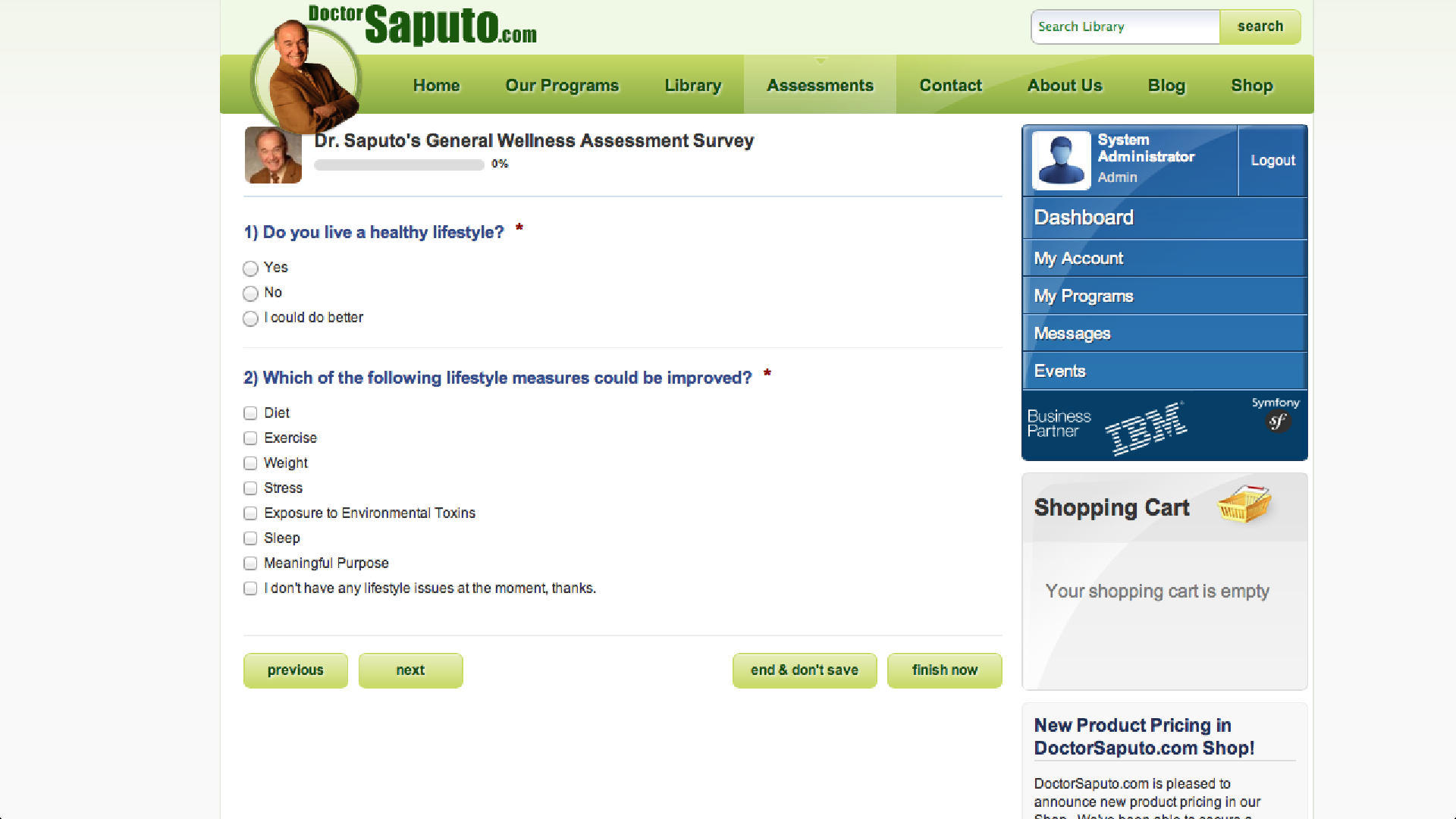 All of the Health Assessments on DoctorSaputo.com have been developed to provide you with integrative and holistic medical information that may help you understand your health condition more fully and share our opinions about possible treatments you may choose to consider with your healthcare practitioner. All of our Health Assessments have been created by Dr. Saputo with the intent of taking just a few minutes of your time and, upon completion, providing instant emailed information in short audio and video files that are specifically related to your unique health condition as determined by the way you answered our simple questions.
 Ductal carcinoma in situ, or DCIS, makes up 25% of breast cancers and is lethal in only 1-2%. Failure to differentiate leads to massive overtreatment, significant emotional and physical disability, and unnecessary treatment and costs. There is a desperate need for better screening tests. Many of these cancers spontaneously disappear.
 Women diagnosed with ductal carcinoma in situ (DCIS) are confused about whether or not DCIS is cancer or not. MDs are no different! About 2% of DCIS cancers are lethal and the other 98% will die with it and not from it. Twenty to twenty five percent of all breast cancers are DCIS. Mainstream treatment for this condition includes surgery, radiation, and chemotherapy. Women and many MDs are questioning this approach, but it is good news for the pharmaceutical companies, surgeons, radiologists, and oncologists because treating DCIS is an extremely profitable business.
 Many breast cancers resolve on their own. Autopsy studies show that about 30% of women in their 50s have occult breast cancers that apparently come and go. It makes one wonder if we are massively overdosing cancer and overtreating them as well. The trick is to know which cancers are dangerous and in need of treatment. Studies on mammograms over time have documented this fact and the data supporting this is presented. We don't have the natural history we need to know which cancers will clear. DCIS (ductal carcinoma in situ) only kills about 1-2% of people...yet most are treated with surgery, chemotherapy, and radiation and they don't need treatment at all!
 The Institute of Medicine (IOM) reviewed data about possible environmental risks for developing breast cancer. They felt that pesticides, beauty products, heousehold chemicals, and plastics might or might not be risk factors for breasts cancer. They did agree that medical x-rays were a clear risk for developing breast cancer. They recommended that MDs avoid ordering unnecessary biomedical imaging.
 Women witlh breast pain who receive imaging as part of their evaluation undergo additional testing with mammograms, ultrasounds, and MRIs are often biopsied. However, they do not benefit according to a Boston University School of Medicine study published in March of 2012 in the Journal of General Internal Medicine. Pain is rarely a presenting symptom for cancer of the breast In their study of 916 women with breast pain only 6 cancers were found, and all of them had either a lump or an abnormal mammogram.
 A Canadian study published in the Journal of Nutritional Biochemistry in February of 2013 proved that omega 3 fatty acids inhibit the growth of breast cancer tumors by 30% and also reduced their size. Previous data about the effectiveness of omega 3 fatty acids showed an association, but this study proved that it is a fact!
 More than 60% of breast cancer survivors report at least one treatment related complication even 6 years after their treatment. Thirty percent are dealing with two issues such as lymphedema, skin reactions to radiation, upper pody symptoms and functional limitations, weight gain, fatigue, and peripheral neuropathy from chemotherapy.
 Consuming cruciferous vetetables after a diagnosis of breast cancer was associated with improved survival in Chinese women, as reported in the Shanghai Breast Cancer Survival Study in April 2012. Nearly 5000 breast cancer survivors with stage 1-4 cancer were followed prospectively over three years. Comparing the highest quartile with the lowest with regard to cruciferous vegetable consumption they found a 27-62% reduction in all cause mortality, 22-62% increased survival in breast cancer specifically, and risk for recurrence of 21-35%.
 Dietary cadmium that is found in the environment and in phosphate fertilizers has contaminated farmlands and may lead to an increased risk of breast cancer according to a study published in Cancer Research in March of 2012. A study of nearly 56,000 women conducted over 12 years showed that higher exposure to cadmium via diet was linked with a 21% increased risk for developing breast cancer. The main sources of cadmium were from bread and cereals, potatoes, root crops and vegetables.
 A study out of Singapore, published in Annals of Oncology in March of 2012, showed that breast cancer patients treated with chemotherapy had symptoms of chemobrain manifested by memory loss, difficulty in decision making and speech problems. Patients were generally not aware they had symptoms because they attributed them to fatigue, anxiety, and mood changes related to the physical side effects of chemotherapy. They were unable to fulfill their duties as mothers and wives because of their cognitive defects.
 Getting less than 6 hours a night of sleep is a risk factor in postmenopausal women with stage 1 or 2, estrogen positive, node negative breast cancer using the Oncotype DX tumor test. It measures the risk of tumor recurrence based on the expression of 21 oncogenes.
 The treatment of cancer today is limited to mainstream therapies that include surgery, chemotherapy, and radiation. In some states like California it is a felony to use integrative CAM therapies. Often times patients have to travel to other states or countries to obtain the treatment they want.
 No one wants to get cancer but if we do, we want to find it early when it might be more curable. Keep in mind that cancer screening is not the same as prevention. There are a wide range of cancer screening tests that are available today that are regularly prescribed by the medical profession that have been assumed with a very limited scientific basis to be beneficial.
 Here at DoctorSaputo.com, we have over 150 media files that are related to breast cancer. If you would prefer to search through them yourself, without the aid of the health assessment,